




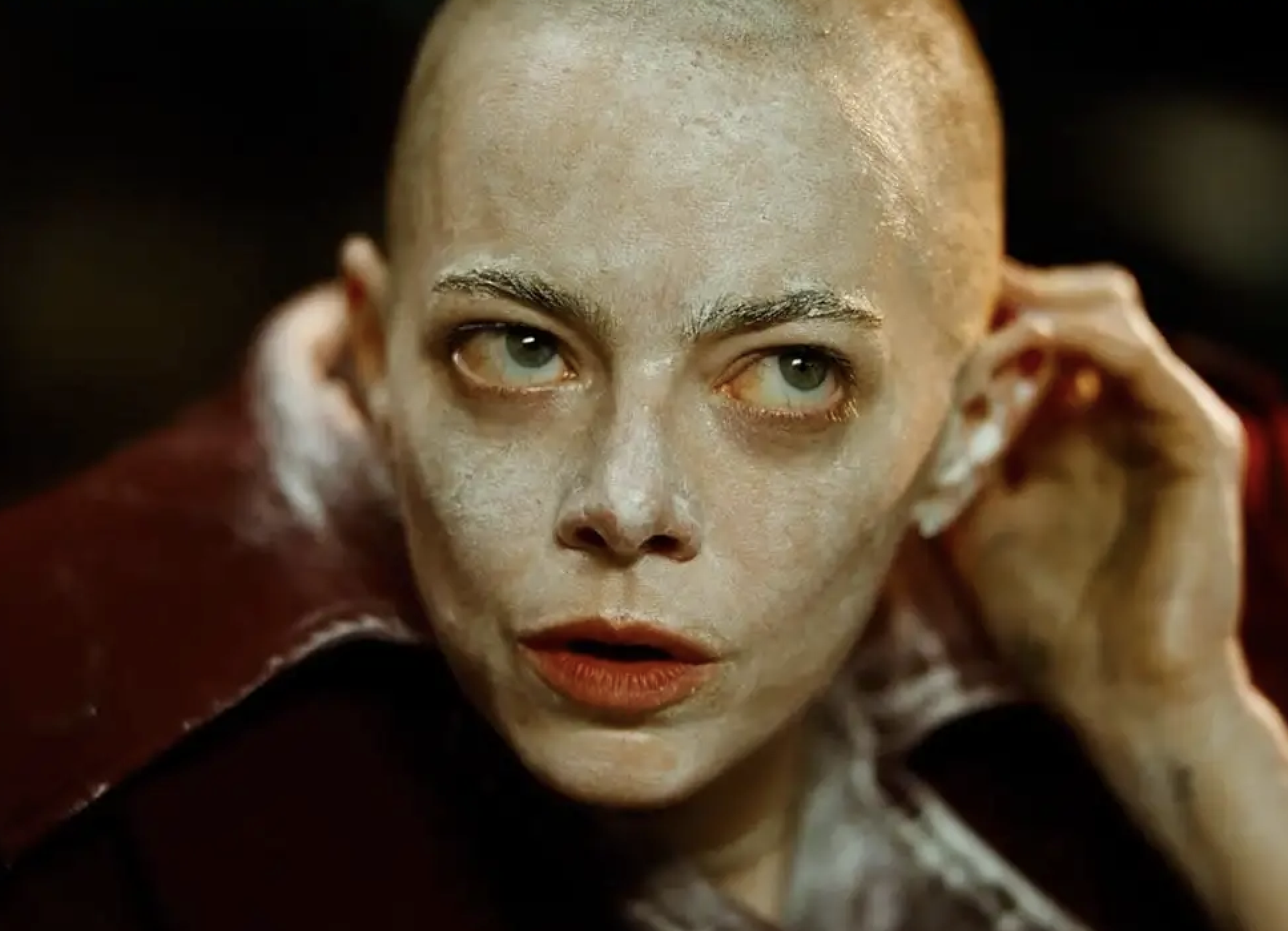
Lanthimos’s conspiracy thriller starring Emma Stone and Jesse Plemons explores the madness of modern paranoia through a twisted version of an alien abduction story that is delightfully deranged and utterly gripping.
This time, he’s remaking Jang Joon-hwan’s 2003 South Korean film as an English-language contemporary thriller. His last film, Kinds of Kindness, was a triptych fable exploring Lanthimos’ trademark boundary-pushing, surrealist plots about human relationships in modern-day society. His previous works dabbled in more distant settings – The Favourite, set in 18th-century England, and Poor Things, set in a kind of atemporal Gothic alternate reality. The absolutely bonkers plot of Poor Things worked in tandem with its equally surreal world, whereas Kinds of Kindness and now Bugonia feature grounded modern settings that peel back to reveal a strange underbelly. Both films hold a mirror up to our bizarre modern world while pushing into fantasy-like territories that act as parables, depending on how much you want to read into them.
Bugonia achieves a more refined version of a modern-day parable, with it being Lanthimos ’most modern-feeling film, magnifying the themes of a dying environment through the lens of a small American town. The story revolves around Teddy (Jesse Plemons), a conspiracy theorist misfit who involves his cousin Don (Aidan Delbis) in a plot to capture big Pharma CEO Michelle (Emma Stone), as he believes she is actually an alien in disguise. It’s essentially an alien abduction story in reverse.
If you think the premise is bizarre or hilarious, you’d be correct. The film does a wonderful job balancing comedic silliness with seriously dark material. The first act excellently sets up the ridiculousness of Teddy’s ideologies, with him prepping his cousin on the evil ways of the ‘Andromedans’ as if they were in the heartwarming beginnings of a Spielberg film. This allows the audience to laugh at Teddy as he spews what sounds like utter nonsense, sympathise with him as he emotionally laments helping his innocent cousin, and then get very creeped out by his complete conviction.
Plemons is doing the acting equivalent of a blindfolded tightrope walk – he’s human and familiar enough that you could imagine him in our world, allowing genuine warmth to come through, particularly in scenes with Don. His earnestness creates an odd comedy – you’re laughing at him one moment, then unsettled by him the next. But as the film progresses and Teddy’s methods become increasingly desperate, Plemons doesn’t hold back on creeping you out with truly horrifying reveals. Hints of Teddy’s backstory justify some of his feelings towards Michelle, and even at his worst (and he gets worse!), his poor mental well-being traces back to trauma that may have been caused by the Michelle herself.
This leads to another great way the film allows sympathy through this dark comedy horror show – through Stone’s performance as Michelle. The screenplay and her performance are a perfect mirror of modern-day patronising corporate-speak. Despite being subject to Teddy’s nasty plot, she somehow comes across as the villain some of the time, with fake half-smiles and condescending lines you’d roll your eyes at on a Zoom call – ‘I’m sure we can reach a mutually beneficial solution’ – whilst trapped in a conspiracy theorist’s basement. Stone’s character is purposefully unreadable. I was never quite sure if I fully felt fear for her, disliked her, or what motivated her, leaving me constantly flip-flopping on what I thought. This is massively to the film’s benefit. One of its core hooks is the looming question of how much of Teddy’s conspiracy theories are complete nonsense, or how much might actually be true. The film dances around these ideas – even after seeing it and knowing the answers, I’m still uncertain about the details and whether what I saw was entirely real. This may be frustrating for some, as Lanthimos’ trademark style favours metaphor and allegory more than plot clarity. Whilst I was often exasperated at the plot’s ambiguity, the film has had strong staying power, and I’m excited to see it again to unpack all of its mysteries.
Cinematographer Robbie Ryan’s work is, as expected, stunning. Despite most of the film taking place in a basement, it maintains considerable visual intrigue. Filmed mostly on VistaVision cameras, the film boasts a distinct, vivid palette that is sometimes over-saturated, amplifying the intense, claustrophobic setting. The camera frames moments with a unique sense of space, sometimes positioning an intense moment far away so you can’t perceive the details and only see the uncomfortable struggle. On the flip side, the camera spends considerable time close to the actors’ faces, bringing the most out of the Oscar-worthy dialogue scenes.
Jerskin Fendrix conducted and composed the score, marking his third collaboration with Lanthimos. The score has a very epic and abrasive orchestral sound – to me, it often sounded like a twisted version of a classic hero’s fanfare – with crashing percussion and triumphantly brazen horns.
For me, this film is delightfully confusing. It balances staying focused on its themes of 21st-century isolation and environmental collapse at the hands of execs, whilst keeping you on your toes with its intriguing plot. I wasn’t so keen on the structure the film divides itself into, as it somewhat spoils what is to come. Short flashback scenes, while being a visual treat, do a bit more telling than showing, which the present-day scenes handle with superior subtlety. If you weren’t too keen on Eddington (which, funnily enough, also stars Emma Stone as a conspiracy theorist), but want something that will really make you say ‘what just happened’ aloud to your TV, I’d recommend this as a more focused conspiracy story that still shines through its weirdness. It’s been a remarkable year for celebrated directors proving they’ve still got creative fire, and Bugonia certainly belongs on that list.

Author: Elliot, Holborn Store