



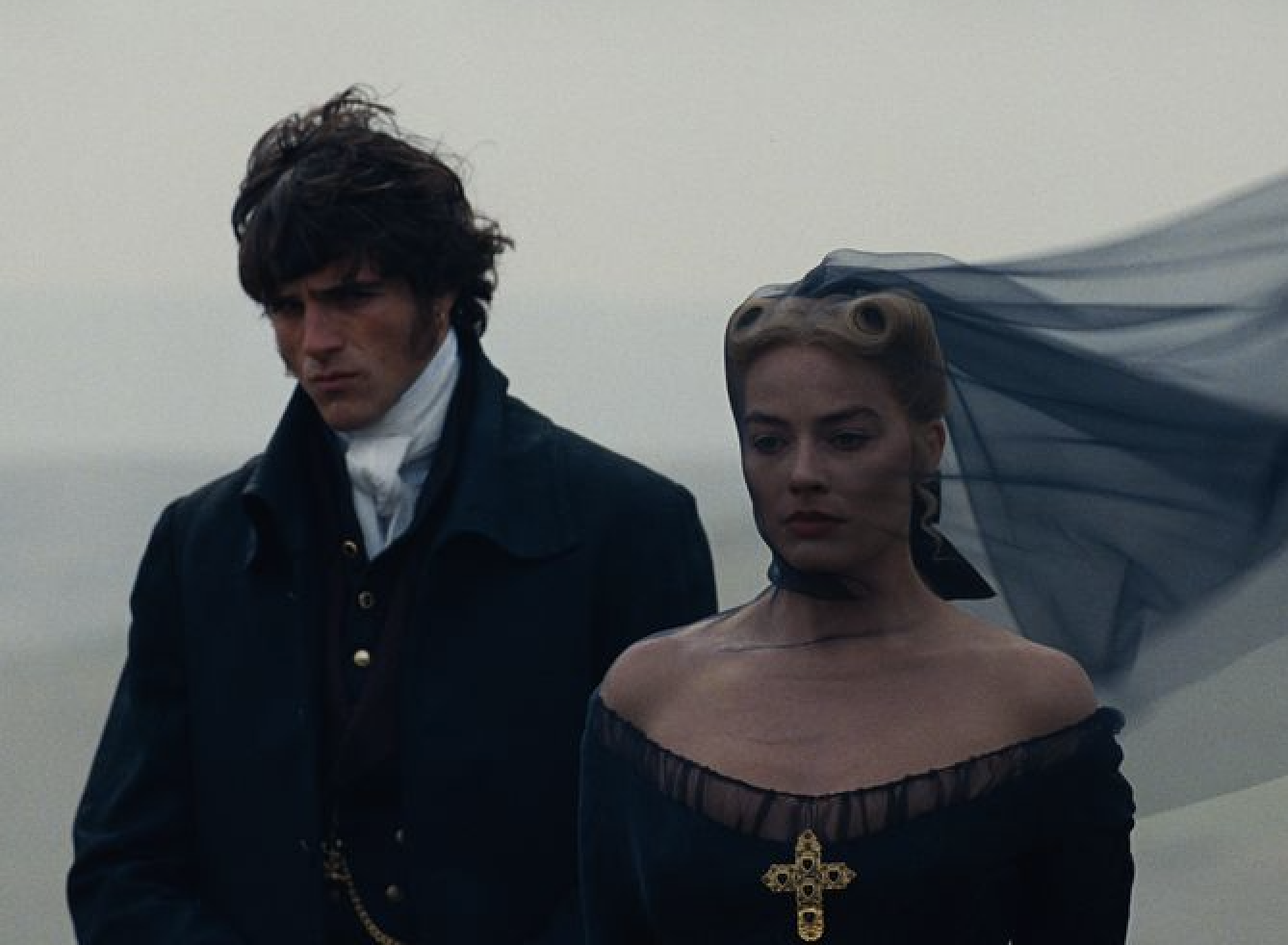
Cathy seeks the ultimate comfort in a beautiful yet loveless financial marriage, though Heathcliff’s undying adoration keeps drawing her back in.
Initially published in 1847 under Emily Brontë’s pen name ‘Ellis Bell’, with purposeful sexual ambiguity; to disguise her then scorned gender through published works, Wuthering Heights was written over two volumes within the same novel. As depicted so many times before on film over the last 87 years – it concentrates solely upon volume 1; or just the first half of the original book. Why, I shall get to this later so again not to spoil this age old story. We now find ourselves within the midst of the gothic literary romance/horror period, where actual physical travel through the world or even one’s own country was at best uncomfortable, or at worst violent through highwaymen robberies. So escape of geography and wealth within one’s own mind through writing and reading were the then go-to’s. And this is where we come to Emily Brontë’s one and only published work, which at the time also had some very mixed, even criticised reviews, is now of course, revered. Emily died just one year later in 1848 at the then still tender age of just 30.
From the stables of “LuckyChap Entertainment” – a female concentric production company with Robbie at the helm – it has produced some highly successful films in recent times including Suicide Squad, Saltburn and of course, Barbie, which went on to gross almost $1.5billion, 10 times its budget. With Emerald Fennell as director – whose first direction was Promising Young Woman – winning awards for ‘best original screenplay’, we are now in this 2026 interpretation. And now for some much talked about casting controversy. Once again Wuthering Heights uses all the wrong ages of actors and in the case of Heathcliff, incorrect background ethnicity.
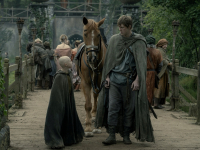
Starring Margot Robbie as our elder Cathy; who in the book is actually between the ages of 15 and 19, dies soon after childbirth. We also have Jacob Elordi, (Saltburn) a fellow Australian actor, as Heathcliff, who is meant to be of ambiguous dark skinned Gypsy or Indian descent. And this is where only one previous adaptation in 2011 before aims to maybe get this correct. Cathy is first introduced as a younger character (6 years of age in the book) and here we have Charlotte Mellington who turned 15 through the launch of this film. An actress well chosen, seeing her acting precociousness shine through here from her antagonistic Lavender character in the stage play of Matilda, and Owen Cooper as young Heathcliff. Through sheer good luck for Emerald, Owen filmed this first before the smash hit Adolescence, which catapulted him to the highest acclaim of youngest actor ever to win an Emmy at the age of 15. The onscreen charm and interaction between Charlotte and Owen is something quite special, even underused, though we do see their charm brilliantly in the closing of the film once the tragedy has struck. With these two actors we are also seeing the dawning once again of amazing young and emerging British talent.
For Emerald, in her words to streamline the characters, both Cathy’s brother and father are melded together in the form of elder Earnshaw, played superbly by Martin Clunes. Emerald was looking for a character of a frustrated put upon ‘stand up’ with no audience and Clunes handles this with great aplomb. Coming across as both brutish and weirdly lovable, Clunes delivers a marvellous performance that seems to stand out amongst the other stars; as if in the best way he is a part of a different direction altogether.
Brontë’s Wuthering Heights, as a writing piece’s sole concern, was not based in romance but of the class system in the early 1800’s, where women had no rights over their husbands within the ownership of physical property. And so we have the juxtaposition of the haves and have nots when it comes to the varying levels of our middle class system. The Earnshaw’s of diminishing middle income with housemaids, though struggling financially later on. We also have the fabulously wealthy brother and sister siblings Edgar and Isabella Linton, played by Shazad Latif and Alison Oliver, (Saltburn (seeing a casting pattern here?)) at the gorgeous Thrushcross Grange. A family made stratospherically wealthy through the hugely popular textiles market that took off around the time of the book. Emerald wanted this film to look as if it was in parts a stage play, with the surrounding dark rocks imposing, even suffocating the Earnshaw’s residence. Then to the other extreme, the stunning Linton’s property, walled off from the real world with stunning primary colours throughout with Cathy’s dresses of the darkest blacks and scarlet blood reds, presenting a breathtaking gothic theme once more. Emerald even used Margot’s actual skin images and blemishes to create her skin type latex fabric wallpaper for Cathy’s bedroom. The film doesn’t really do justice to the set design, and is worth diving into online for the stunningly intricate details including the blue crystal and red velvet rooms.
And last but not least, we have Charli XCX’s amazing soundtrack. Initially and hopefully wanting even one track from CXCX, Emerald was offered an entire album which was used here throughout and is in most parts, superb. With tracks including the stand outs of Always Everywhere, a low key yet beautiful melody of Cathy’s omnipresence after death, and House featuring John Cale, a track depicting the gallows though the higher pitched violins as the creaking wood. Lastly, with Chains of Love… as Cathy becomes enveloped in the sheer beauty of Thrushcross Grange.
There is so much to be said about this version, some have loved it, others have berated it. If you’re not into stylish period dramas then this is not for you. With an opening scene that will most certainly catch one off guard, this is highly stylised in the best possible way; taking us away from the previous tawdry; almost sepia examples that were trying and indeed again, mostly failing to actually depict Wuthering Heights in its truest literary form. A love triangle at its heart where the boy aims to get the girl who is seeking another boy with a comfortable normality; though Cathy’s temper impedes her own choices at each and every turn.
Will Wuthering Heights ever be made true to the literary version – of which I have actually read – and at the same time be worthy of the largest screen with the best sound and indeed soundtrack? One may never know. Is this perfect? No. Is this the best adaptation? For me, yes. Despite the hate online, Wuthering Heights remains a gorgeous hit grossing at the time of publication, approaching $160million and counting. With 12 further projects currently in the pipeline under “LuckyChap Entertainment”, Robbie is not looking to rest on her positively pink laurels.

Author: Piers, Maidstone Store