




QNED vs OLED: The Expert’s Take on TV Picture Tech
If you’re shopping for a new TV this year, you might have noticed something interesting about the acronyms on the boxes. Alongside the famous OLED screens, you’ll see a bright, colourful challenger: QNED.
At Richer Sounds, we know that an acronym is only useful if you know what it actually does and how it enhances your TV. So, let’s leave the engineering manual on the shelf and get straight to the practical differences in this QNED vs OLED comparison.
The True Rival: Mini LED vs OLED
First, we must clarify that the true technical rival to OLED is not just QNED, but the wider category of Mini LED backlighting. Mini LED screens are engineered to deliver black levels close to those of OLED (though not quite achieving them), with the added benefit of a significantly brighter overall image.
This is where QNED steps in. You will exclusively see the term used by LG, because “QNED” is LG’s specific brand name.

The “QN” Factor: What is QNED?
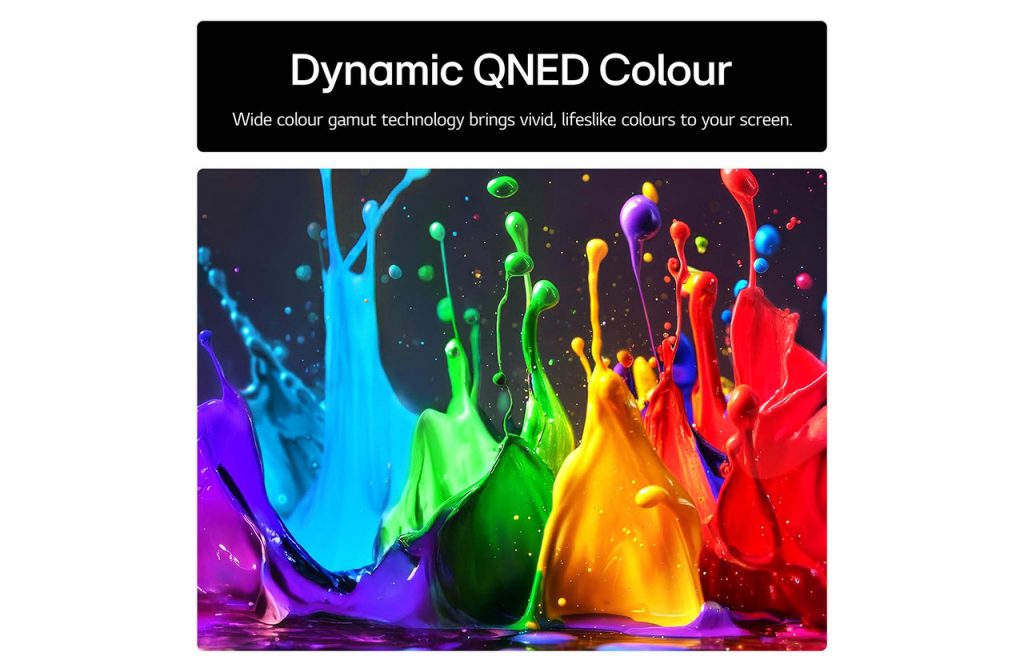
QNED stands for “Quantum Nano Emitting Diode.” Think of it as a super-hybrid of LED TV technology that turbocharges the standard LED screen by combining two distinct colour-boosting technologies into one panel:
- Quantum Dots: These are tiny crystals that emit precise colour when light hits them.
- NanoCell: This is a filtering layer that removes dull, impure light wavelengths to ensure the colours you see are clean and vibrant.
This specific combination is also why you will exclusively see the term used by LG. While other big brands have similar technology – Samsung calls theirs “Neo QLED”, and Hisense uses “ULED” – the “N” in QNED stands for NanoCell, which is LG’s own proprietary technology. So, while the concept of mixing dots and LEDs isn’t unique to them, a true QNED TV is an LG speciality.
This unique combination in a QNED screen produces a massive volume of colour that standard screens simply can’t reach. Most premium QNED models also use “Mini LEDs” for their backlight. Imagine thousands of tiny lights behind the screen rather than just a handful; this gives the TV far better control over brightness and contrast than older LED models.
The “O” Factor: A Quick OLED Recap
You may already be familiar with OLED TVs (Organic Light Emitting Diode), but the crucial difference here is the light source.
QNED relies on a backlight to shine through the pixels. OLED does away with the backlight entirely. Instead, the panel is “self-emissive,” meaning every single pixel creates its own light. To show black, an OLED pixel simply turns off. This process is what guarantees perfect black levels and infinite contrast, defining the technology. It’s also important to note that LG is the number one OLED brand and supplies panels to other manufacturers, though Samsung is also a main OLED panel supplier.
For a detailed deep dive into this technology, read our dedicated OLED and QLED technology guide.
Head-to-Head: QNED vs OLED
As these two technologies handle light so differently, they excel in distinct environments. When weighing up LG QNED vs OLED, forget the spec sheet for a moment – it helps to think practically about the unique lighting and usage habits of the room you are putting the TV in.
1. Brightness: The Daylight Test
If your living room has floor-to-ceiling windows or you watch a lot of TV with the lights on, QNED is often the smarter pick. The premium QNED MiniLED models use a powerful, independent backlighting system that can deliver significantly higher peak brightness than most standard OLED panels. This raw power allows the image to cut through reflections and ambient glare, keeping the picture punchy and visible even on a sunny afternoon.
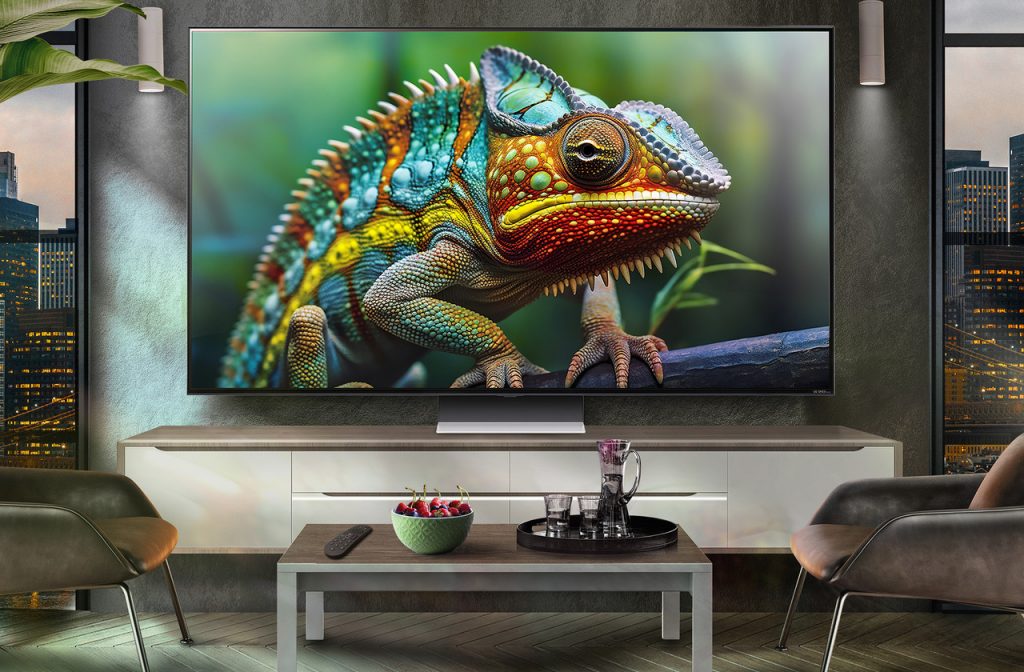
LG 86QNED91T6A
2. Contrast: The Cinema Experience
In a dark cinema room, an OLED screen shows true-to-life black. A QNED screen, while excellent, may still show very faint “blooming” (a slight halo of light) around bright objects like streetlights or stars, because it still relies on a backlight to illuminate them.
3. Longevity: The “Burn-In” Question
A significant advantage for QNED is peace of mind. The technology uses inorganic LED pixels, which are physically immune to screen burn-in. While modern OLEDs have massive protections against this, QNED remains the stress-free option for households that leave static news tickers, gaming HUDs, or paused menus on screen for hours at a time.
4. The “Bad Seat” Test (Viewing Angles)
For households with a wide sofa or a busy living room, the ‘bad seat’ problem is a real consideration. This is an easy win for OLED. With light emitting directly from the screen surface, the picture maintains perfect colour and contrast regardless of where you are sitting. QNED screens have certainly improved – particularly LG’s models that use wide-angle IPS panels – but the picture can still look a little washed out if you end up viewing from a sharp angle.
Ready to find the perfect screen for your space? Find the best TV for your room in our expert guide.
Hisense 65U7QTUK
5. Gaming: Speed, Detail, and Immersion
When chasing the fastest refresh rates and lowest input lag, OLED holds the advantage.
The self-emissive nature of OLED pixels allows them to transition from off to on almost instantly, and response times are near-instantaneous, measured in a fraction of a millisecond. This translates to absolute clarity in high-speed gaming, offering superior motion clarity with virtually no motion blur.
However, the question of longevity must return here. If your gaming sessions involve long hours with static screen elements (such as persistent health bars, score displays, or a heads-up display/HUD), the burn-in resistance of a QNED panel offers unparalleled security. For the most demanding competitive gamers, the pure speed of OLED is king; for the avid, all-day player, the robustness of QNED may offer a less anxious experience.
Explore our experts’ top picks of the best gaming TVs in our guide.
The Verdict: Is QNED Better Than OLED?
Technically speaking, OLED is widely regarded by industry experts as the superior technology for pure cinematic picture quality, specifically regarding black levels and contrast.
However, QNED is often preferred for specific practical scenarios. It’s generally more affordable than OLED, especially at larger screen sizes (think 75-inch and above). It’s also arguably better suited to very bright rooms where OLEDs can struggle.
Which Route Should You Take?
The easiest way to decide isn’t just from the specs. Our experts have simplified the decision-making process even further, helping you choose based on scenarios and lighting conditions:
| Scenario | We recommend QNED if… | Go for OLED if… |
|---|---|---|
| Viewing environment | Daytime viewing: Your room is bright, airy, and prone to glare. | Cinema Feel: You dim the lights for movies and want those perfect, inky blacks. |
| Key priority | Size matters: You’re searching for a massive wall-filler of a screen without the premium price tag of a giant OLED. | Picture priority: You value superior contrast and shadow detail above all else. |
| Build & maintenance | Peace of mind: You want zero anxiety about your screen | Design: You want an exceptionally thin screen. |
Find Your Perfect Picture at Richer Sounds
Reading about the tech is helpful, but nothing compares to seeing it. You shouldn’t have to guess which picture you prefer.
Pop into your local Richer Sounds store, and we will happily set up a demo. We can run the same footage on an LG QNED and an LG OLED, so you can judge the brightness and contrast with your own eyes. We’re here to help you find the right TV for your home, not just the one with the most hype.