



An Introduction to Dolby Atmos Surround Sound
Dolby Atmos is the biggest leap forward in home entertainment since the arrival of surround sound itself. While you have likely seen the name on the latest home cinema products, understanding what it actually does for your ears is the key to a better setup. We’ve broken down the essentials to help you decide if it’s the right fit for your home.
What is Dolby Atmos?
Dolby Atmos is an innovative surround sound technology that creates a complete 3D audio experience in your home. While traditional systems are restricted to a horizontal plane, Atmos adds a vital height dimension. This allows audio to move freely around and above you, creating a lifelike ‘dome’ of sound that puts you right at the centre of the action.
To get the most out of an Atmos setup, it helps to understand the fundamentals of speaker placement. If you are new to home cinema, read our guide to 5.1 speaker systems to see how these core components form the building blocks of a 3D system. By building on this foundation, you can experience better detail and realism than ever before.
How Dolby Atmos Compares to Traditional Surround Sound
The primary difference between Atmos and traditional surround sound lies in how the audio is delivered to your ears. Standard 5.1 or 7.1 systems are channel-based, meaning sound is sent to specific speakers, such as front-left or rear-right. Dolby Atmos is object-based. This allows sound to move independently of the speakers in a three-dimensional space, providing a far more fluid and lifelike experience.
In a traditional setup, sound is generally restricted to ear level, creating a horizontal circle of audio. Atmos introduces dedicated height channels, which means a rainstorm actually sounds like it’s falling from the sky rather than just around you. As Dolby Atmos handles sounds as individual objects, the audio is significantly more precise, allowing you to track the exact path of an aircraft flying overhead or the subtle movement of a character walking on a floor above you. This shift from a 2D soundstage to a 3D environment is what truly sets it apart from older technology.
For a comprehensive look at how these systems compare, explore our surround sound systems guide.
Essential Equipment: Compatible AV Receivers
To unlock Dolby Atmos, the brain of your system needs to be a compatible AV receiver. This unit decodes object-based audio data in your films and games, determining which sound goes to which speaker.
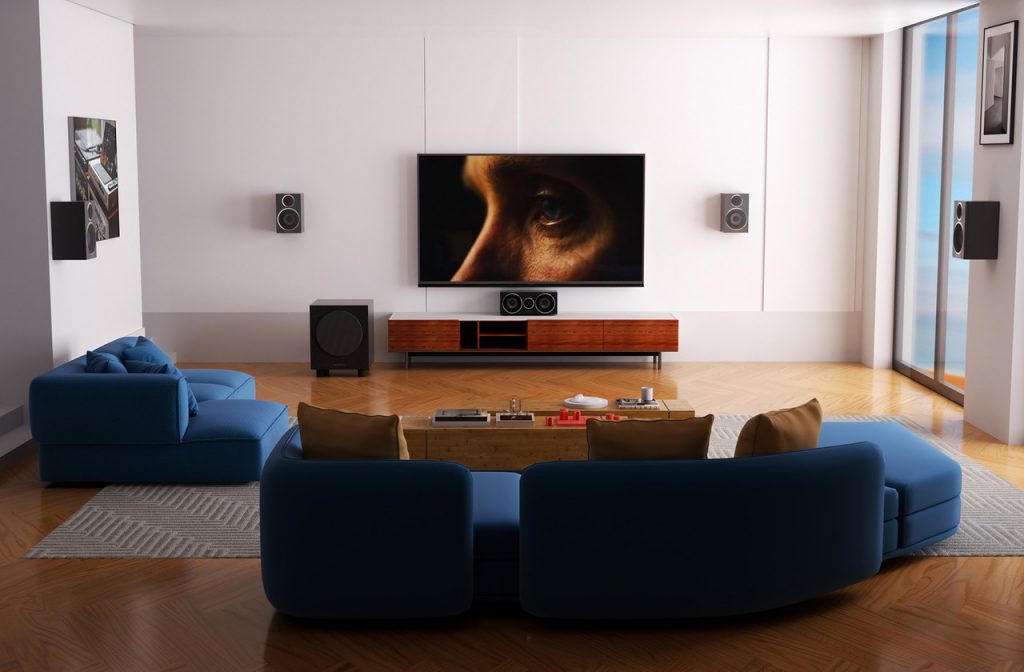
When choosing a receiver, look for the number of channels it supports. A standard Atmos setup is often described as ‘5.1.2’. This means you have five traditional speakers, one subwoofer, and two dedicated height channels. If you have a larger room, you might opt for a ‘7.1.4’ receiver to enhance immersion. Modern receivers also come with handy calibration software. This uses a plug-in microphone to listen to your room’s acoustics and automatically adjust the sound to give you the best possible performance in your space.
Adding the Height Dimension to Your Home
To truly experience the 3D potential of Dolby Atmos, you need speakers that can place sound above you. There are two primary ways to achieve this, and the right choice usually depends on your room’s layout and how much DIY you are prepared to do.
Downward-Firing Speakers
These are mounted on or in the ceiling. They are frequently wedge-shaped and tuck in where your wall meets your ceiling, projecting sound directly down onto the seating area. For a more discreet look, many Atmos speakers can be mounted flush into the ceiling, remaining almost completely out of sight while maintaining a professional finish.
A model like the Monitor Audio Bronze AMS 7G is specifically engineered for these 3D formats, offering a perfect fit for a high-quality home cinema setup. For those seeking a dedicated, high-performance option, the Focal 100 ICW6 provides a superb coaxial design that ensures a wide spread of sound, so everyone in the room gets the full Atmos effect regardless of where they are sitting.
Upward-Firing Speakers (Atmos Modules)
These speakers are a bit more flexible and project sound upward, where it bounces off the ceiling and back down to the viewer. You can place them on top of your existing front speakers or on either side of your TV. They are a fantastic option if you don’t want to cut holes in your ceiling or run cables up the walls. Just make sure they have a clear, unobstructed path to aim at the ceiling.
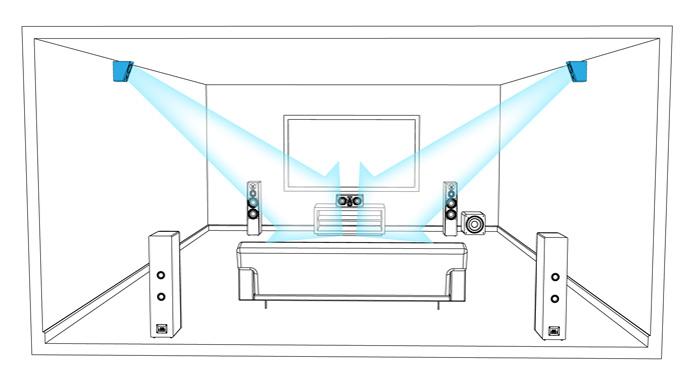
For those looking for flexibility, the Klipsch R-40SA is a standout choice as it can either sit on your floorstanders to bounce sound or be wall-mounted as high-level surround speakers. For a truly cohesive soundstage, matching your Atmos modules to your existing speakers is key. The Wharfedale Diamond 12.3Di is designed specifically to complement the Diamond 12 series, ensuring the tonal balance remains consistent throughout the room. Similarly, the Triangle Borea BRA1 is a perfect match for the rest of the Borea range, allowing for a seamless transition as sound moves from the front of the room to the space above you.
Many modern Atmos speakers are versatile enough to be used in both upward and downward positions, so you are not tied to a single setup if you later decide to change your room layout.
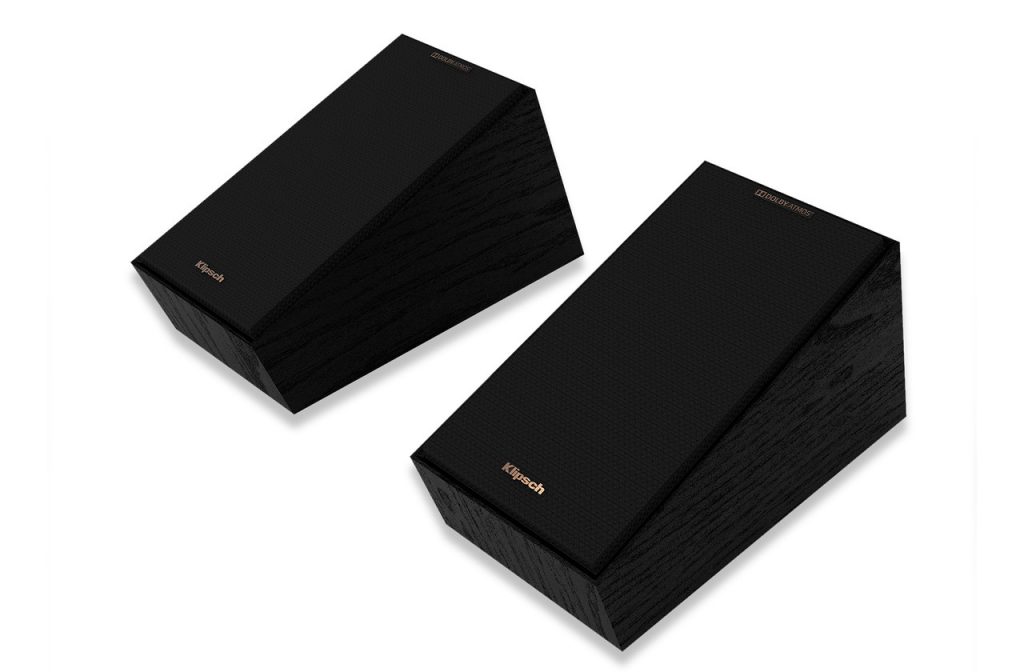
Klipsch R-40SA Dolby Atmos Speakers
Comparing Soundbars and Component Systems
Deciding whether soundbars are as good as surround sound often comes down to your specific room layout and performance goals. High-end Atmos soundbars are an ingenious solution for smaller spaces or minimalist setups. They use internal upward-firing drivers and clever digital signal processing to simulate 3D audio from a single unit, providing a massive leap in quality over standard TV speakers. You can find more details in our guide, An Introduction to Soundbars.
However, a dedicated component system, comprising an AV receiver and separate speakers, offers a different level of immersion than a soundbar. By positioning each speaker physically, you create a much larger sweet spot, ensuring the 3D effect remains convincing no matter where you sit.
Separate speakers also house larger, higher-quality drivers and dedicated cabinets, allowing for greater dynamic range in the soundstage. For a deeper dive into this comparison, read Speakers vs Soundbars: The Expert’s Take on Home Audio.
Determining if Dolby Atmos is worth it
For anyone looking to experience better movies and gaming, Dolby Atmos is the most significant leap in audio technology in decades. Beyond action scenes, it adds subtle ambient detail to every genre, making Dolby Atmos worth it for those seeking total immersion.
For gamers, the benefits are even more practical; Atmos provides a competitive edge through spatial awareness, allowing you to hear the exact height and direction of footsteps or gunfire with pinpoint accuracy. To complete the experience, take a look at our guide on The Best Gaming TVs for Smooth, Lag-Free Play.
Expert Guidance at Richer Sounds
We stock a comprehensive range of Dolby Atmos products, from the latest feature-packed AV receivers to high-performance speaker packages and soundbars.
Our in-store experts are always ready to answer your questions and provide a live demonstration so you can hear the difference for yourself. Give your local Richer Sounds store a call or pop in for a chat today!