



YouTube indie-horror legend Kane Parsons (AKA Kane Pixel) brings liminal horror to the big screen with Backrooms.
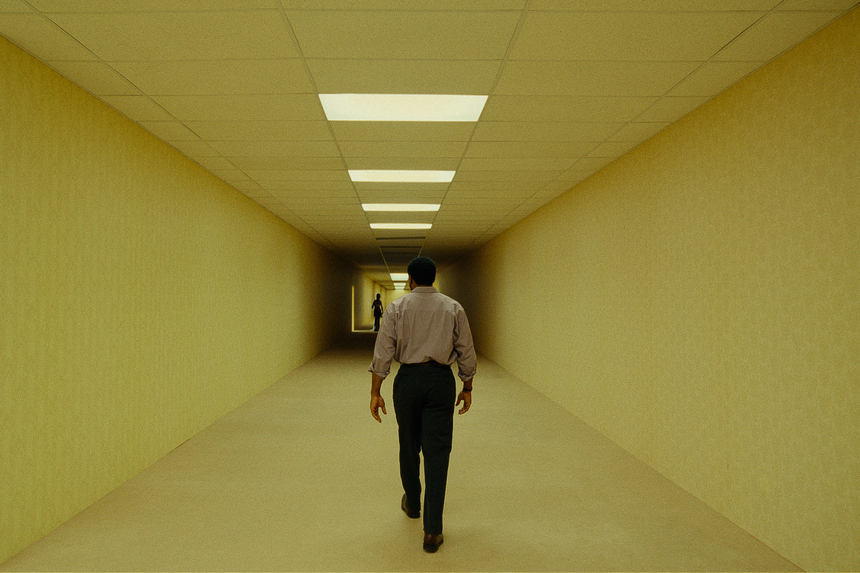
Adapted from his own YouTube mini-series, each a self-contained horror vignette in a ‘found footage ’format, Backrooms does an effective job of introducing new audiences to this internet urban legend and deepening the experience for fans. The original Backrooms YouTube series was inspired by a 4chan thread from 2016, in which an image of an isolated, dewy yellow office space prompted a user to envision a creepy landscape called ‘The Backrooms’. The user described that if you’re not careful, you could accidentally phase out of reality into a parallel reality. An endless, abandoned liminal space, ‘The Backrooms’ are a maze of office-like rooms and corridors that feel like a glitch in reality, “where it’s nothing but the stink of old, moist carpet, the madness of mono-yellow, the endless background noise of fluorescent lights at maximum hum-buzz” infinitely.
Kane Parsons then realised this environment in 3D rendering software Blender, and created a series of videos set in the Backrooms. In each of the videos, an unknown person is trapped exploring this liminal space, with their nightmare shown to the viewers as a hand-held camera POV perspective (think The Blair Witch Project meets Office Space).
Cut to 2026, where Kane Parsons has been able to fulfil this vision with the funding and production of A24, to bring this original horror to the mainstream. This underdog story alone had me excited to see and support this film. Thankfully, with the Backrooms film, Kane Parsons effectively adapts his work to a more cinematic scale, whilst maintaining the unique heart of what makes his flavour of horror so effective. If you’re not at all aware of the Backrooms original series – not to worry! In my opinion no prior knowledge or expectation could have braced me for the creative and original filmmaking on display.
The film centres around Clark (Chiwetel Ejiofor), and his struggle with keeping his professional and personal life above water. Helping him is his therapist, Mary (Renate Reinsve), who is trying to guide him out of repressed rage following his divorce. One day, a frustrated Clark finds a slither of a doorway in the basement of his failing furniture store, which leads to his first encounter with the titular Backrooms. Chaos and horror ensue as Clark invites his employees and eventually Mary to explore this space with him.
The film’s most immediately commendable asset is its commitment to atmosphere. Parson’s original YouTube Backrooms content almost relied entirely on atmosphere to deliver unease – getting this right to satisfy the length and depth of a feature film was paramount. It’s so effective here – in the ‘real ’world, the set design, colours and cinematography have an uncanny valley vibe to immediately put the audience off kilter. In the Backrooms, expanses of physical sets help sell the dizzying infinite aspect of this environment. Randomly placed furniture and props, some of which are sunken into the floors or ceiling, almost feel like tumours. The camera work captures the engulfing scale of the endless rooms with deep, wide shots complimented by patient editing, with long takes utilised to match the feeling of the slow descent into a maddening maze.
The use of hand-held camera POV has to be mentioned and commended, too. There are a couple of extended sequences in the film that throw back to Parsons ’original use of ‘found footage ’POV – these are some of the most chaotic and heart-pounding moments of the film. When this film hits physical release, an OLED or RGB display (or any display with great HDR formats) will bring the most out of the deep yellow environments.
The sound design and original score do so much to elevate the atmosphere. The score, composed by Edo Van Breemen and Kane Parsons himself, is very reminiscent of the environment it accompanies – slow, hypnotic and eerie. Rhythmic textures are swallowed by reverb, vocal samples are distorted beyond recognition, and synth pads ebb and flow in pitch so intensely that it’ll make you feel seasick. Fans of Aphex Twin or Oneohtrix Point Never will get a huge kick out of the OST.
One key component of adapting Backrooms successfully as a film is that it would have to have a plot, themes and characters to explore, in contrast to the mostly plotless YouTube series. This is where I think the film will be the most divisive. The plot on the surface seems simple, but it turns out to be a confusing web that creates more answers than questions. As much as I think this is intentional, as a more esoteric approach to themes and characters mirrors the Backrooms in itself, it does require a lot of patience from its audience. Character backstories are revealed briefly and not returned to directly, and there are hints dropped that give us a brief peek behind the curtain, but things are left so unexplained you’ll be left more confused. When the film ended, I was desperate for more – to the film’s credit as it was due to the effectiveness of the experience, but also to its detriment, as I did feel slightly unsatisfied.
The film definitely has a more tunnel-visioned focus on atmosphere, although I did find its explorations of themes very compelling. The way the Backrooms reflect the different ways Clark and Mary tackle past trauma, in that the environment they’re stuck in is very cyclical but distorted, stuck with me long after my viewing – there’s certainly a lot up to interpretation.
Backrooms was one of the most confident films I’ve seen from a debut director, let alone a 20-year-old one. It has one of the most well-crafted atmospheres of dread that I’ve ever experienced in a cinema. Not to be hyperbolic, but whilst walking through a quiet cinema back to my car after the credits rolled, I found the eeriness of the liminal horror really got under my skin. It is very Lynchian in its pure focus on themes and vibes over any concrete answers. Fans of Twin Peaks, The Shining or Eraserhead will really enjoy this eerie nightmare.

Author: Elliot, Holborn Store