



 There are two types of people in this world: those who have heard of Nick Drake, and those who haven’t. His audience is still far smaller than it deserves to be, and every time I meet someone who doesn’t know him, I try to introduce them to him.
My own Nick Drake journey began in the early 2000’s thanks to those omnipresent “100 Best Albums to Hear Before You Die” and “Albums You Must Take With You When Leaving Earth to Set Up a Colony on Mars” lists that magazines like Rolling Stone, Mojo, and NME loved to publish when they needed to gain subscribers. Drake’s name kept appearing on these lists with the album Five Leaves Left, so I thought I’d give it a listen. I’m glad I did — it’s been in my top twenty albums ever since. The delicate folk arrangements, Drake’s intricate guitar work, his hushed voice, and the elegant string orchestrations by his Cambridge friend Robert Kirby create something quietly magical. But it was Drake’s story — sad, fragile, and strangely uplifting — that really grabbed my attention.
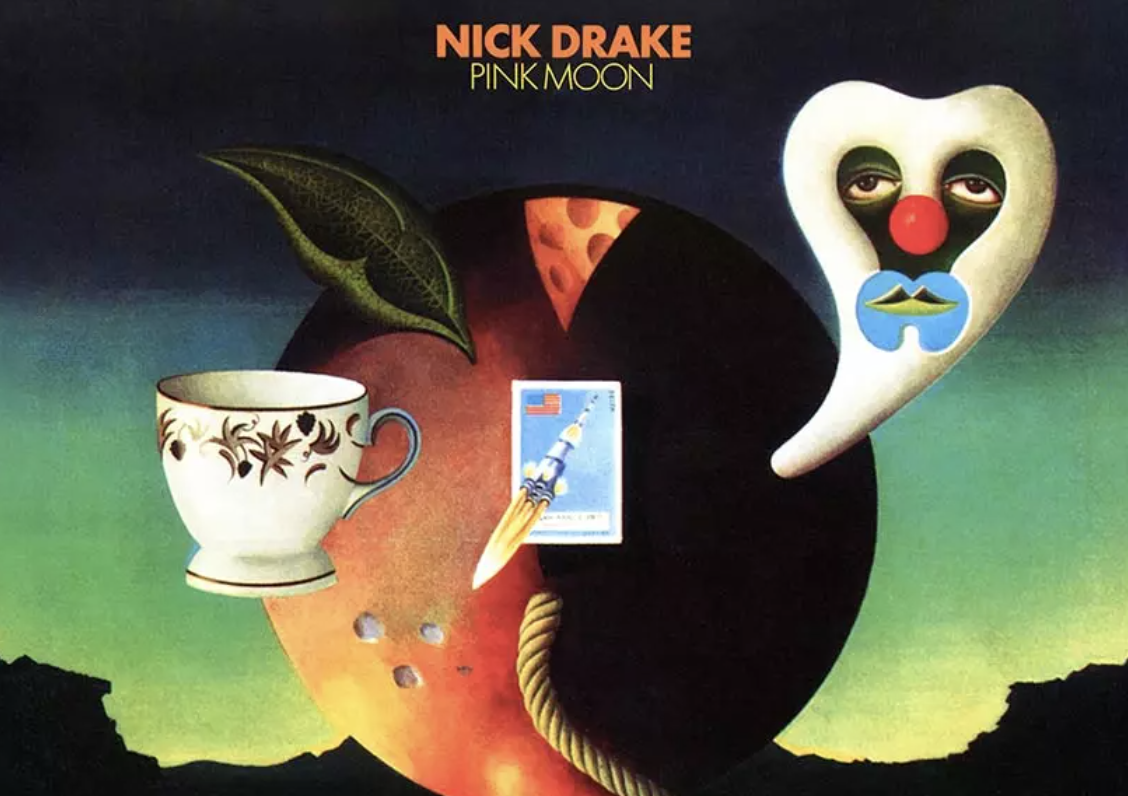
Drake was discovered at Cambridge University by producer Joe Boyd and signed to Island Records. His debut, Five Leaves Left (1969), sold modestly. His second album, Bryter Layter (1971), broadened his sound with fuller arrangements and jazz-inflected warmth, yet sold even fewer copies — around 3,000. Disheartened and increasingly withdrawn, Drake retreated from performing and recorded his third and final album, Pink Moon (1972). It received little attention at the time, and Drake’s mental health continued to decline. He died in 1974 at just 26.
I’m going to admit this upfront: despite twenty years of devotion to Five Leaves Left, I never really gave Pink Moon the attention it deserved. I’d heard it occasionally at friend’s houses in the background, or parties, but it never became part of my regular rotation. That changed when I picked up the 2013 vinyl reissue earlier this year. Since then, it has become one of my favourite albums — now firmly in my top twenty — and it always follows naturally after a spin of Five Leaves Left.
Pink Moon is stripped back to the absolute essentials. Aside from a brief piano overdub on the title track (played by Nick), it’s just Drake’s voice and acoustic guitar. No harmonies, no double-tracking, no studio trickery. Nothing. Yet the songs are astonishingly beautiful. Drake’s lyrics are poetic and sometimes ambiguous, relying on imagery rather than narrative, encouraging listeners to find their own meanings.
When recording the album, Drake reportedly sat facing a wall and played each song live, with only the occasional re-take and just engineer John Wood present. Wood later said he assumed these were just demos, to be embellished and recorded properly later. To re-record any of these songs or embellish them would have been a travesty! — and hearing the album now, it’s impossible to imagine it any other way. The 2013 pressing is impressively clean, with minimal noise. I believe that this is an all-analogue pressing, taken directly from the master tapes and it shows, with no hint of any digital clean-up or added silence. The guitar isn’t sparkling or forward — it’s warm, rounded, and intimate, exactly as it should be for an album that feels like Drake is sitting a few feet away from you. His vocals sound like he’s singing for himself, not wanting to trouble anyone, yet still come across as strong and important.
My personal highlights include Pink Moon, Place to Be and Which Will. But honestly, there isn’t a bad track here. On first listen, the instrumental Horn seems pleasant, but ultimately forgettable; However, with each new play, you begin to hear the ache in his playing and realise how much is actually being said without words. That’s the magic of this album — it reveals itself slowly, quietly, and honestly. Don’t get me wrong — this is not a depressing album in any sense. There are genuinely uplifting moments throughout Pink Moon, but knowing Drake’s story helps you put the songs into context. This was Nick’s last desperate go at recognition.
In the decades after Drake’s death, his work slowly resurfaced. Reissues brought his albums to new listeners, and interest grew steadily. By the 1980s and 1990s, he had become a cult figure, cited as an influence by artists such as The Cure, R.E.M., and Kate Bush.
A major turning point arrived in the late 1990s when Pink Moon appeared in a Volkswagen commercial, introducing Drake to an entirely new generation. Today, his albums sell hundreds of thousands of copies annually, and Pink Moon is widely regarded as one of the greatest folk records ever made. The poignancy lies in the fact that the recognition Drake longed for arrived, only after his death.
After Drake finished recording his final album, he turned up unannounced at the Island Records office, handed the master tapes of Pink Moon to the receptionist without explanation, and quietly left. Two years later, he was gone.
“Now we rise, and we are everywhere” – Epitaph on Nick’s gravestone, taken from the lyrics to the final song on Pink Moon.

Author: Jim, Colleague Support