



 More than thirty years later, Arrow Video have given the original trilogy the kind of deluxe 4K treatment physical media collectors dream about. And honestly, this release feels like it was made by people who genuinely understand what these films mean to a certain generation.
If you grew up at exactly the right time in the late ‘80s and early ‘90s, the Teenage Mutant Ninja Turtles weren’t just another cartoon, they were absolutely… everywhere. Toys, lunchboxes, duvet covers, school bags, VHS tapes, cereal promotions… it was impossible to escape them. And for a lot of us who were around eight or nine when the first live-action movie hit in 1990, that film felt huge. Darker than the cartoon, moodier than expected, but still funny and weird enough to absolutely connect with kids.
The first thing to say is that the original 1990 film still holds up remarkably well. Not just through nostalgia either, it’s still easily the strongest film in the trilogy by some distance and that’s been backed up by fan opinion for years now. What’s fascinating revisiting it now is how unlikely its success actually was. The production was famously difficult, independently financed, surprisingly low budget for the ambition involved, and dealing with practical creature effects that could easily have looked ridiculous. Instead, Jim Henson’s Creature Shop (based in London at the time) somehow pulled off suits that still look tangible and expressive decades later and yet somehow ended up looking worse by the end of the sequels. The film itself also has a rougher, grimier New York atmosphere that feels much closer to the original Mirage comics than the cartoon most of us knew at the time. Even as a kid you could sense it was not the cartoon but wasn’t playing down to us or being overly ‘cartoony’ or patronising… it’s that edge that’s made it just as watchable at 42 as it was at 8 years old.
From John Du Prez’ amazing score that perfectly captured that late-80’s mood, to the amazing direction from British director Steve Barron. Up until this point, Barron had made a name for himself directing some of the most iconic music videos of the 80’s, including A-ha’s ‘Take on Me’ and Michael Jackon’s ‘Bille Jean’. His rough and ready, imaginative style lent itself perfectly to this world, which on the surface COULD be seen as cheesy, but somehow feels more real than many of the so-called family/child-oriented films of the time.
The sequels are a different story. Secret of the Ooze is still very entertaining and for some reason a favourite of the three for some people, but I never got that. However, the film clearly shifts harder into ‘toy-commercial’ territory. The tone becomes broader, sillier, and much safer. You can almost feel the studio sanding off the darker edges after parents complained about the intensity of the first film. Even going so far as to ban ALL use of their ninja weapons throughout the film… settling for a more ‘Jackie Chan’ use of everyday objects around them to dispense with the baddies. They brought back The Shredder and turned him into a joke, which I always thought was a huge shame. He wasn’t scary anymore and turned out to be little more than the straight guy for all the bumbling idiots and creatures around him. And the less said about Vanilla Ice’s musical appearance the better.
And TMNT III… well, it’s probably best described as charmingly chaotic. Even as a kid I remember sensing something was ‘off’ with it, particularly the cheaper-looking costumes (due to not having the budget for Jim Henson’s company). But oddly, age has made me warmer towards it… it’s still the weakest of the three, but there’s something oddly comforting about its low-budget early-‘90s weirdness now. Do I think time travel was a stretch too far in a movie about mutant ninja turtle?… maaaaaybe, but hey. There’s some genuinely amazing cinematography in the film, like the incredible opening shot of ninjas on horseback, riding in slow-motion while a giant red sun rises in the background.
What Arrow have done exceptionally well here is treat all three films seriously from a restoration perspective, even if the films themselves vary wildly in quality. The first movie especially looks phenomenal in 4K. Not “modern blockbuster” sharp, obviously, this is still a gritty 35mm production from 1990, but it finally looks filmic again instead of waxy or artificially cleaned up like older Blu-ray releases sometimes did. This was a total re-scan of the original camera negatives, colour timed and restored properly. Black levels are deep, and colours feel far more natural than previous home releases. The nighttime scenes finally have proper shadow detail without turning into a muddy mess. You can see texture in the costumes, dampness in the alleyways, and detail in the production design that genuinely wasn’t obvious before. Especially with the first film, New York has never looked so good in a movie to my eye.
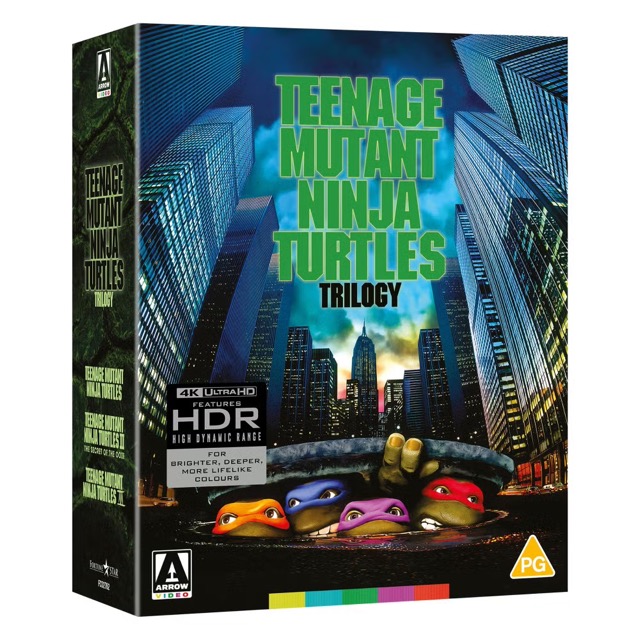
This impressive 4K Blu-ray boxset, is a must for all TMNT fans!
There’s been some online debate about the amount of grain in the transfer, but personally, as somebody who still loves projected film and older physical media presentations, I think Arrow absolutely made the right call leaving it intact. Grain is what gives a film image ‘Life’ and to take it away, takes away that organic feel that is so much part of my memory of watching it. Some viewers used to heavily processed streaming-era transfers may initially find it surprising, but on a properly calibrated display it looks authentic and cinematic rather than noisy… especially on an OLED.
The HDR grading also deserves praise because it doesn’t go overboard. Neon signage pops nicely, sewer lighting has more depth, and skin tones finally stop leaning into the strange orange push older releases sometimes had. The biggest improvement overall is consistency, these films now feel stable and natural rather than over-processed.
The second film probably benefits the most from the restoration in some ways. Secret of the Ooze always looked flatter and brighter on previous releases, but here there’s more depth and colour separation throughout. It still has that lighter, more cartoonish visual style compared to the original, but it now feels cleaner and more detailed without looking artificial. Both the second and third films were not a ground-up restoration like the first film, they’re taken from older HD masters and just given a tweak for this release. But I’m fine with that, in fact, if they’d just released the first film by itself, I may have questioned even buying the second and third.
TMNT III is interesting because while it remains visually the weakest production, Arrow’s restoration probably presents it better than it has ever looked at home. The wider daylight photography actually benefits nicely from HDR, and the Japanese period costumes and outdoor scenery occasionally look surprisingly rich in 4K. It doesn’t magically become a better film, obviously, but it looks exactly like it should.
Audio-wise, the first film gets the premium treatment with a new Dolby Atmos mix alongside original theatrical stereo options. Thankfully, the Atmos track is respectful and restrained, dialogue remains front-focused, but the score has much more space around it and environmental effects… rain, city ambience, sewer echoes, subtly expand the soundstage in a really pleasing way. The original score especially sounds fuller and warmer than I’ve ever heard it at home, although comparing it to my Blu-ray release I thiiiiink that opening theme tune may just hit slightly harder on the previous version. Or maybe it just wasn’t as refined as the Atmos mix? It’s up to you to decide, lol.
The sequels stick mainly to DTS-HD Master Audio presentations, and honestly that’s perfectly fine. These aren’t films crying out for aggressive surround remixing. What matters is clarity, preservation and balance. The dialogue is stronger, the music has more punch, and the low-end during action scenes finally carries some weight.
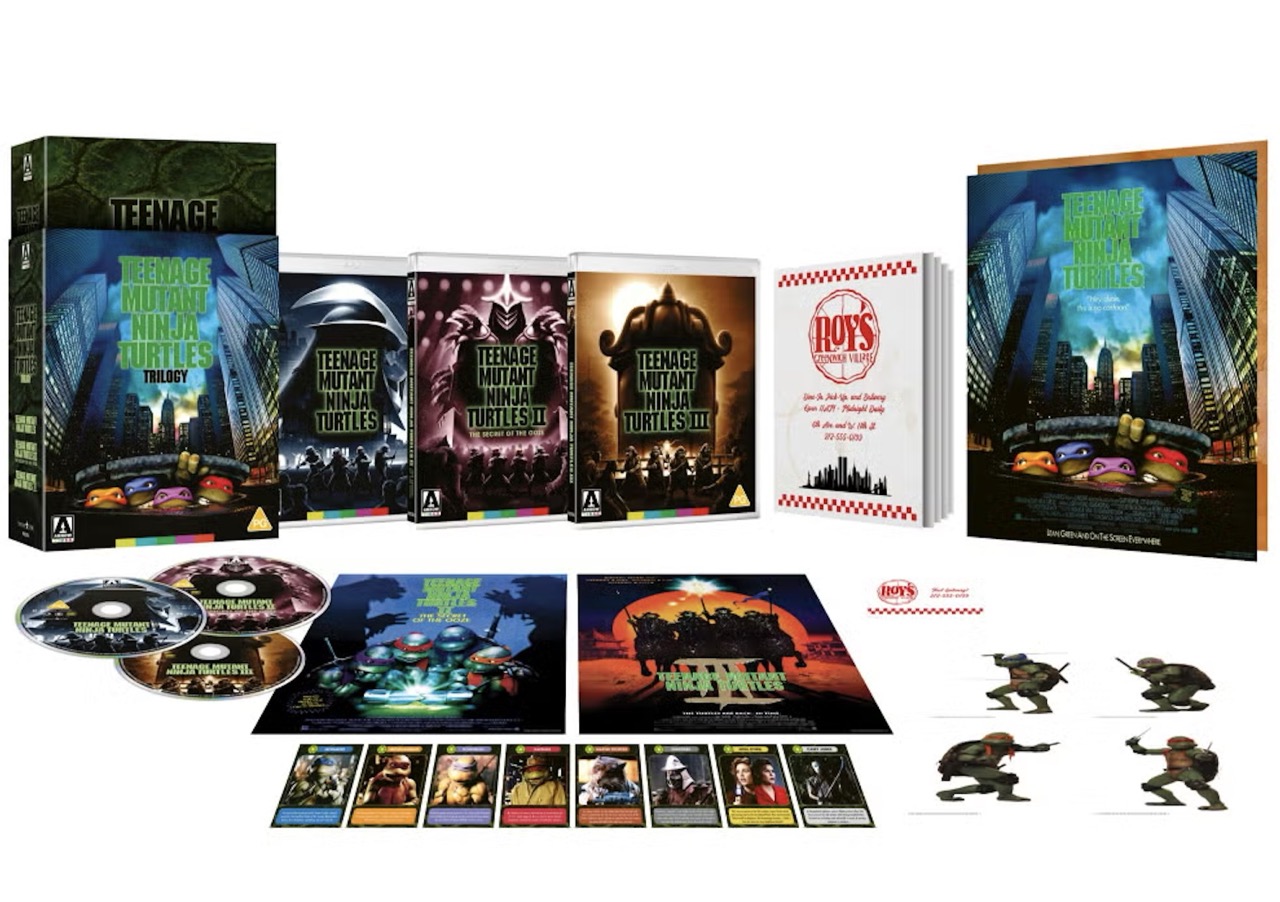
Where Arrow really justify these premium releases though is the packaging and supplements. This is exactly the sort of set physical media collectors still get excited about. The outer box is sturdy and beautifully designed without feeling cheap or gimmicky. Each film gets its own individual case with reversible artwork, and the newly commissioned artwork actually works surprisingly well alongside the classic imagery, although give me the original poster version any day.
The extras themselves are extensive to say the least. New interviews, archival material, commentary tracks, retrospective features, there’s an enormous amount to go through. Arrow continue to excel at contextual material rather than just dumping EPK ‘fluff’ onto discs. The included booklet is especially good, with essays and production material that feel written for actual fans rather than padded marketing copy. The pizza-menu-style presentation of the booklet is exactly the kind of nerdy detail physical media people love.
Then there’s all the collector material packed into the box, posters, art cards, trading cards, and thankfully most of it feels tasteful rather than disposable filler. It walks that fine line between nostalgia and quality surprisingly well. It genuinely feels like opening a premium collector’s item from an era where studios still cared about physical presentation.
And honestly, Arrow Video deserve enormous credit generally for the way they approach these releases. They’ve become one of the few labels that still understand why collectors buy physical media in the first place, it’s not just about owning the movie, it’s about preservation, presentation, context and giving films the care major studios often no longer bother with. Even imperfect films get treated with respect and that’s increasingly rare.
As someone now in his early forties (Oh, God) who wore out VHS copies of these films as a kid, this set hit me harder emotionally than I expected. Watching the first movie again in this quality genuinely transported me back to that exact period where the Turtles felt like the centre of the universe for a few years. And while the sequels don’t quite reach the same heights, there’s still a huge amount of affection wrapped up in all three films.
For TMNT fans, nostalgia collectors, or physical media enthusiasts in general, this is without a doubt, the definitive version of the trilogy. It’s lovingly restored, beautifully packaged, and packed with worthwhile extras. More importantly, it feels curated by people who actually care about these films and the generation that grew up with them.
The phrase ‘Cowabunga!’, apparently, still works on this middle-aged man!

Author: Arron, Marketing Department