



Christopher Nolan’s take on Homer’s Odyssey is a modern, inspirational, and deeply personal spin on one of humanity’s oldest and greatest stories.
When I say modern, I don’t mean modern in period or setting – it’s still very much ancient Greece – but modern in its interpretation of the poem’s themes: legacy, the collapse of society, and the guilt of a man who was supposed to protect the people he left behind.
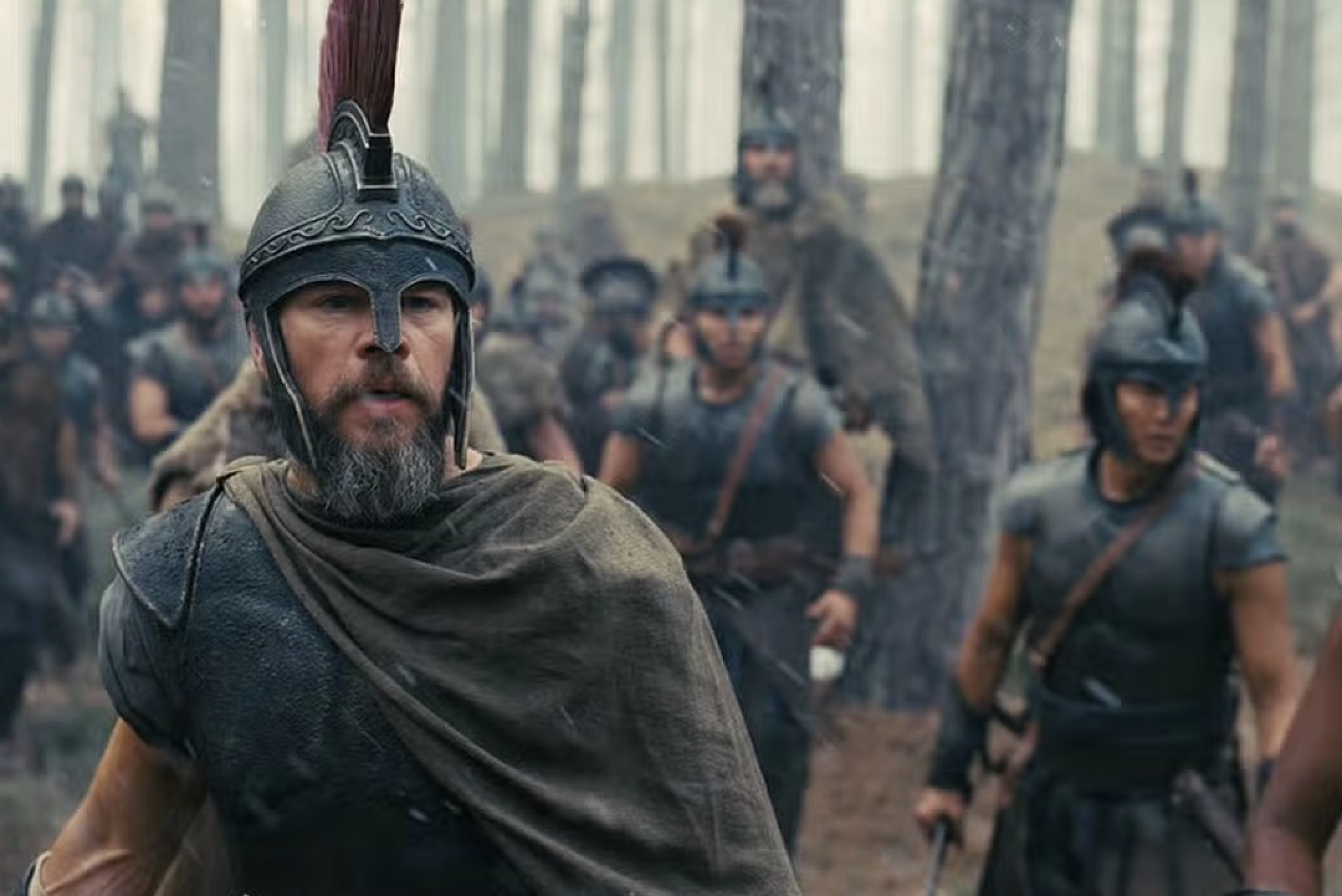
Matt Damon leads as Odysseus, King of Ithaca, a decade removed from the fall of Troy and desperate to get home. Tom Holland plays his son Telemachus, who barely remembers his father and sets off in search of him. Anne Hathaway plays Penelope, holding Ithaca together against a hall of suitors led by Robert Pattinson’s Antinous.
The opening act was spotty on my first viewing – lots of non-linear storytelling (typical of Nolan) and hints of large timeline jumps have your brain whirling straight out the gate, plus a fair amount of exposition to set the stage. That mix of fragmented narrative and meandering dialogue left a slightly dull impression on first watch. Once the film establishes its structure and formally introduces Odysseus, his men, and the journey ahead of them, though, it finds its stride.
The film’s first notable moment is the encounter with the Cyclops Polyphemus, and it’s here that Nolan’s practical instincts announce themselves – the creature is realised through a towering, sixty-foot puppet built on set, combined with an actor’s live physical performance rather than a digital creation added later. It has me convinced Nolan could pull off a genuinely terrifying horror film if he wanted to – he sort of does with this one. He’s been getting increasingly comfortable using cinema to convey psychological and mystical torment, and he goes further here than anything he’s done before. The sequence reinvigorated the same childlike wonder and horror I remember from reading The BFG for the first time: the monster is slightly recognisable yet completely twisted, and it envelops the cinema with its scale and sound design. The scene, like many others, also showcases Odysseus’s genius as well as his folly – hubris and its dangers are a core theme throughout, and the film never lets you forget his cleverness and his recklessness are the same trait wearing two faces.
I could go on praising individual sequences. The inevitable Trojan Horse flashback takes an oddly grounded approach, emphasising the genuine horror and claustrophobia of the plan rather than playing it as a triumphant highlight – and it’s here that Nolan plants the seed for his biggest departure from Homer. Rather than a clever tactical masterstroke, the film frames the Horse as a betrayal of some unwritten code of honourable conduct, and lets Odysseus watch the resulting slaughter of Troy with the dawning horror of a man realising what he’s actually done. It’s a small addition to the text, but it recasts everything that follows – his ten lost years stop reading as punishment handed down by capricious gods and start reading as something closer to self-inflicted exile, a guilty man unable to let himself come home.
Then there’s the sequence where the crew meets Circe, played by Samantha Morton, who steals the film for the roughly fifteen minutes she’s on screen. Nolan dives headfirst into body horror here, and it will stick with you in your nightmares. Back on Ithaca, any scene shared by Anne Hathaway and Robert Pattinson is acting excellence, particularly one late exchange where both of their true intentions are finally brought to the surface.
More than the third-act action, it’s Odysseus’s return home to Penelope – a long, patient monologue rather than a triumphant reveal – that makes for one of the strongest third-act sequences in any Nolan film. It’s patient, deeply emotional, and recontextualises the classic tale at large. It’s a brave interpretation, and a commendable one, because it doesn’t ruin characterisation from the original Homer poem – it embellishes it, and reads between its lines.
There’s been a lot of talk about the IMAX of it all, and for good reason. Modern cinema has been embracing large-scale formats as an artistic endeavour more than ever, and we’re all the better for it – this year’s excellent Project Hail Mary, the upcoming Dune: Part Three, and now The Odyssey, the first full-length feature ever shot entirely on IMAX. Nolan and his team had to redesign the camera format itself, developing a new, quieter IMAX camera and rigging a custom mirror device so actors could see their co-stars while the hulking cameras sat between them.
Is the effort warranted? Undoubtedly – so much so that the film vaguely suffers from it. Of my two viewings – one standard 70mm, one IMAX 70mm – I enjoyed and understood the film in IMAX staggeringly more. Because it was shot for IMAX’s full frame throughout, anything less than a true IMAX screen crops out roughly a third of the image, top and bottom, leaving action scenes messier and the grandeur of the practical sets diminished. As much as that’s a pain, the dedication to the true result is worth it – I’m glad Nolan went for a no-compromises approach, even if it means some audiences will miss out.
Ludwig Göransson returns as composer, and I enjoyed his approach – particularly the repeating motif in the “Sirens” track, which resurfaces in that emotional homecoming monologue. Reportedly at Nolan’s own instruction, Göransson ditched the orchestra entirely, building the score instead around ancient Greek instrumentation, scrap metal, and gongs, with vocals carrying much of the emotional weight.
So where does that leave The Odyssey? A slightly messy opening act, a strong and unique second act, and a third act so momentous it will occupy your thoughts for days. But tallying it up like that undersells what Nolan’s pulled off. He’s taken a text adapted more times than almost anything in the Western canon and found something genuinely his own in it: not a hero brought low by the gods, but a man brought low by himself, and a homecoming that has to be earned through honesty rather than triumph. This is Nolan at his most technically ambitious and his most emotionally exposed at once – and that combination makes The Odyssey one of the finest things he’s ever made.

Author: Elliot, Holborn Store